
The Wason Selection Task: A Brilliant Window into Human Reasoning – But What Does It Really Mean?

Love smart videos about fun and interesting topics?
Me too! Though I often I disagree with them — even when they’re excellent.
I recently watched a fun episode of The Rest Is Science with hosts Hannah Fry and Michael Stevens (Vsauce). In it, they tackled one of the most fascinating psychology experiments out there: the Wason Selection Task, also known as the four-card problem.
It’s a gem of a study from 1966 by Peter Wason, and the hosts do a terrific job breaking it down with wit, clarity, and an engaging British-American-collaborative podcast style.
If you haven’t watched it, I highly recommend it — it’s accessible, thought-provoking, and makes you feel smarter just for viewing it. And if you want to avoid spoilers, watch the video first, before you read further!
The Experiment, Summed Up
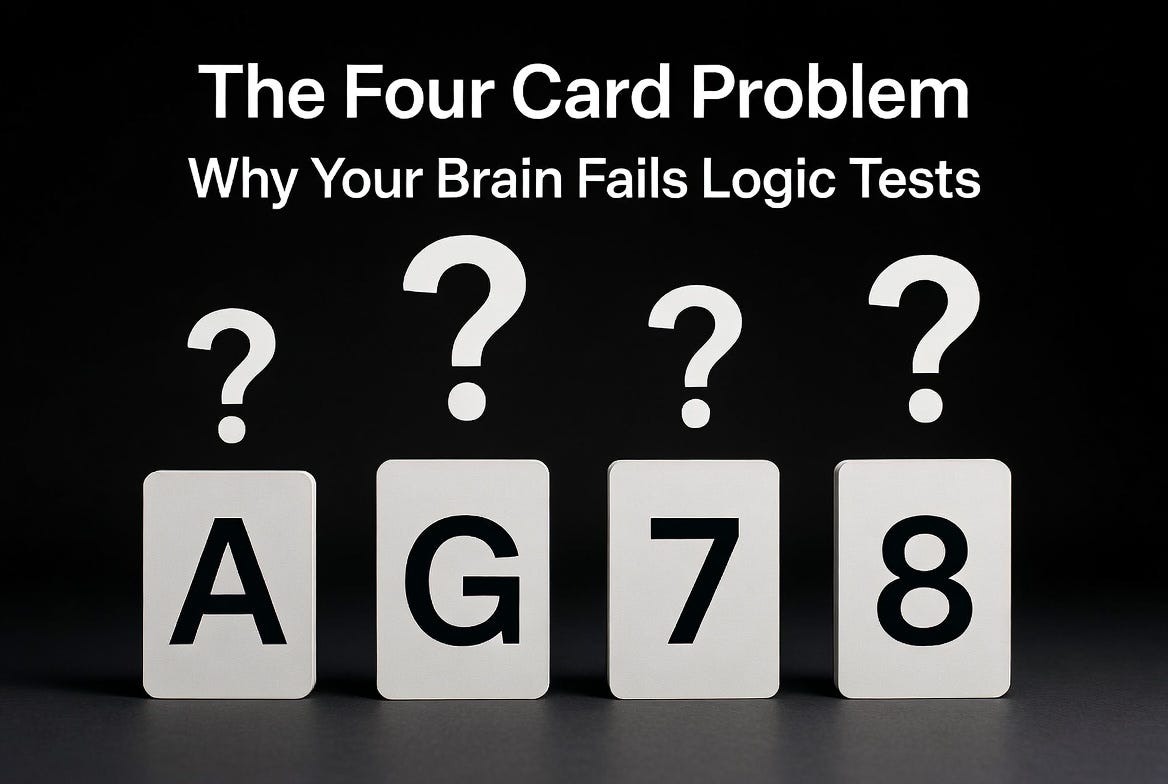
In the classic abstract version, you’re shown four cards: A, G, 7, 8. You are told that each has a letter on one side and a number on the other. You are given a rule: “If there is an A on one side, there is a 7 on the other.”
The test: Which card(s) do you turn over to test if the rule holds?
Most people (around 90%+) pick either A alone or A and 7 — hunting for confirmation.
Wrong answer. Test failed. The correct move is to turn the A (to check for a non-7, which falsifies the rule) and the 8 (to check for an A on the back, also falsifying the rule). The G and 7 are irrelevant.
It’s a test of falsification over confirmation bias, and we humans tend to bomb it — at least when put to us so abstractly.
But flip it to a real-world social scenario — say, a legal rule for a pub: “If you’re drinking alcohol, you must be over 21” — and performance dramatically improves.
People intuitively nail this cheater-detection version: Check the underage person and the alcohol consumer. Weird, right?
The hosts explore why this gap exists, touching on confirmation bias, basic logic like modus ponens and modus ponens (check that wiki I just linked to!), and evolutionary angles.
They’re smart, witty, and make complex ideas fun. It’s the kind of content that sparks real curiosity about how our minds work. Good show. Good channel.
The Evolutionary Take: Solid But Incomplete
To explain these strange results, Fry and Stevens lean on ideas from evolutionary psychology, especially the argumentative theory of reasoning (see Mercier and Sperber).
They suggest our reasoning faculties didn’t evolve primarily for abstract truth-seeking or lab-style logic. Instead, they’re tuned for social navigation: persuading others, winning arguments, detecting cheaters in reciprocal exchanges, and managing group dynamics in ancestral environments.
They say that explains why we tend to flub the abstract test but easily nail the social version — we’re wired for cooperation, fairness enforcement, and spotting freeloaders, not pondering floating logical puzzles.
It’s a compelling argument, and it aligns nicely with a human-nature-first view. We’re social primates, after all. Our tools for reasoning shine brightest where stakes feel real and relational.
Abstract vs. Concrete, Not Just Social.
That said, I think the two hosts slightly miss the core distinction here.
It’s not purely “abstract versus social.” It’s abstract versus concrete/real-world. The bar scenario isn’t just “social” — it’s grounded in tangible, everyday implications with immediate consequences: age, drinks, rules that matter in the real world.
That’s the environment our reasoning evolved to handle — solving practical conundrums in the actual world we inhabit, where survival, reputation, resources, and reciprocity matter — and matter immediately.
Floating abstractions (letters, numbers, arbitrary rules attached to nothing) are hard for us to care about or focus on. They feel artificial. Concretes, though? Those are the stuff of life.
Our minds excel at them because that’s what natural selection rewarded: navigating real threats, opportunities, and social contracts in a messy, concrete reality. Puzzles with cards? Not so much.
Liberals Missing the Essence of Liberalism
Switching gears a little: during the episode, Fry and Stevens also mused thoughtfully about how to improve democracy — perhaps drawing from ancient practices like “draft a leader” lotteries.
In so doing, they come across as deep, clever, engaging people, pondering radical solutions to today’s earnest problems.
But: it’s frustrating when otherwise intelligent and earnest people overlook the obvious. These two smart people discussed improving “democracy”, but never even mentioned the most important aspect: the size and scope of the government in question.
What limitations on democratic power are essential for a free and prosperous people? How do we prevent majorities (or elites) from trampling individual rights, voluntary exchange, and spontaneous order?
Nope, none of that was mentioned. The conversation stayed safely within the Overton Window of assuming more/better governance tools, without questioning the coercive monopoly at its heart. Statism’s track record of expanding power, cronyism, and unintended consequences gets an unexamined pass.
Real progress toward peace and prosperity comes from constraining coercion, respecting voluntary association, and aligning institutions with our evolved human tendencies — not endlessly tweaking the democratic machinery.
On Science, Logic, and Innateness
One lingering question the episode raises (and I’m still pondering): Are science and formal logic native or instinctual to humans?
We have capacities for pattern recognition, causal inference, and social reasoning — baked in by evolution, no doubt.
But the systematic, falsification-heavy, abstract rigor of modern science? That feels more like a hard-won cultural technology — evolution “offloaded to the cultural layer”, as I’ve heard evolutionary biologist Bret Weinstein say.
Science is powerful precisely because it fights our natural confirmation biases and abstraction struggles. We’re not born scientists; we become them through discipline, institutions, and cultural evolution.
Overall, the video is a winner for highlighting these quirks of the mind. It’s entertaining and insightful. But from a Haman Nature lens — using human nature as our guide toward voluntary, peaceful prosperity — it stops short.
We need to go deeper: embrace the concrete strengths of our reasoning, constrain our urge to dominate others, and build systems that work with our nature, not against it through endless top-down “improvements.”
If you watch the video (and I hope you do) what do you think?
Naturally,
Adam
Wouldn’t you need to test all the cards? Because for any 3 of 4 the rule could hold, but then fourth could violate the rule.
One of the major failing of our education system is that advanced mathematics is taught independently rather than in conjunction with physics to provide concrete use cases for trigonometry and calculus. It’s amazing this simple experiment hasn’t changed our approach to math.